
FOUR40 Homes and Contracting (647) 473-3454
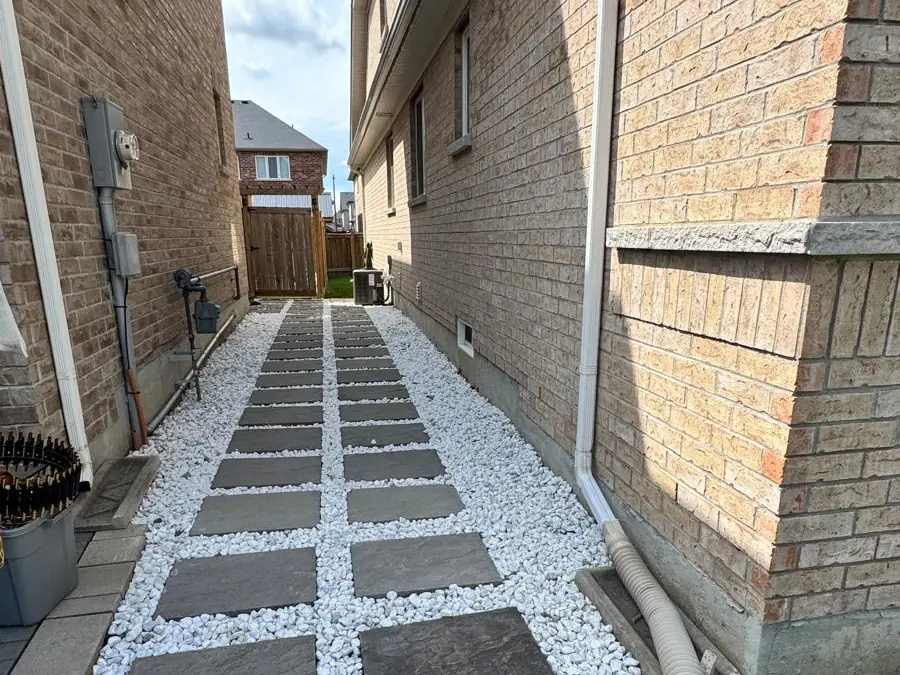
Finished paver walkway set in white decorative stone

Why driveways heave in Ontario.

Freeze-thaw is the mechanism behind almost every hardscape failure in this province. Understanding it takes about two minutes and changes how you read every quote you are given.

Based in
Whitchurch-Stouffville
Estimates
Free & on-site
Before we start
Written scope
On site
Same crew throughout

The mechanism

Water expands when it freezes.

Roughly nine percent, and it does so with enough force to lift a driveway. Water held in or under the base has nowhere to go when it freezes, so it lifts whatever sits above it. In spring it thaws and drains away, leaving a void — and the surface settles into it unevenly.

Autumn

  • Rain saturates the base
  • Poor drainage holds it there
  • Fine soil has migrated into the stone over the years
Winter

  • Held water freezes and expands
  • The surface lifts
  • Repeated freeze-thaw cycles, not one

Southern Ontario cycles through freezing many times a winter, not once.

Spring

  • Ice thaws and drains
  • A void is left behind
  • The surface settles unevenly into it

This is the year-on-year damage.

What prevents it

Four things, in order of importance.

Drainage

  • 2% minimum slope away from the house
  • Free-draining granular base
  • Downspouts extended past the surface
  • Somewhere for water to actually go

The real mechanism. Everything else supports it.

Base depth and compaction

  • 300 mm under a driveway
  • Placed in 75–100 mm lifts
  • Compacted between each lift
  • A stable platform that does not consolidate further

Separation

  • Non-woven geotextile between base and subgrade
  • Stops fines migrating up into the stone
  • Preserves the drainage path over years

Cheap on install day, impossible to add later.

Reading a quote

What to ask, and what the answers tell you.

Cross-section of a properly built interlocking driveway From the top: 80 millimetre pavers, 25 millimetre HPB bedding, 300 millimetre compacted Granular A base, geotextile fabric, and compacted subgrade, with a 2 percent slope away from the house. HOUSE 2% MIN. SLOPE AWAY FROM FOUNDATION 300 mm COMPACTED SUBGRADE UNDISTURBED SOIL
Fig. 1 — The section that resists it
  • 80 mm
    Driveway-grade pavers
    80 mm units under vehicles, 60 mm on walkways and patios. Using 60 mm on a driveway is the most common shortcut in the trade.
  • 25 mm
    HPB bedding course
    Screeded high-performance bedding, kept to one inch. A thick sand bed is a rutting problem waiting to happen.
  • 300 mm
    Granular A base, compacted in lifts
    12 inches under a driveway, 150 mm under walkways and patios — placed in 75–100 mm lifts and plate-compacted between each one. One deep dump of gravel compacts on the surface and stays loose underneath.
  • Fabric
    Non-woven geotextile
    Separates base from subgrade so your clear stone doesn't slowly migrate into the clay. Cheap on install day, impossible to add later.
  • Edges
    Restraint spiked at 250–300 mm
    Polymeric sand swept and set into the joints. Edges are where interlock starts to walk apart.

Four questions: how deep is the base, in how many lifts is it compacted, is there geotextile, and what is the slope? A quote that cannot answer those is quoting a surface, not a driveway.

Questions

Questions, answered.

My driveway lifted this winter and settled back in spring. Is that normal?

It is common, and it is not fine. Seasonal movement means water is being held under the surface and freezing. Each cycle disturbs the base a little more, so what looks like a surface that recovers is a base that is progressively failing.

Can heaving be fixed without a full rebuild?

Sometimes. If it is localised, lifting the area, correcting the base and improving drainage solves it. If the whole surface moves, the base was never right and no amount of resetting the top will change that.

Does more base always mean less heaving?

Depth helps, but drainage is the real mechanism. A deep base that traps water still heaves. What you want is a deep base that drains, sitting on a subgrade separated by geotextile, sloped so surface water leaves.

Free estimate

Tell us about the project.

Fill this in and we'll get back to you to book a site visit — usually the same day.

Or call directly(647) 473-3454

Step 1 of 3 — what do you need?

Step 2 of 3 — the project

Got photos? Text them to (647) 473-3454 after you send this. A photo of the driveway or room lets us quote far more accurately, and often faster.

Step 3 of 3 — where to reach you

Turnstile spam protection is wired up and switches on as soon as the site key is added — see the handover notes.

We only use your details to quote this project. No lists, no sharing. See our privacy policy.

Call now Free quote