
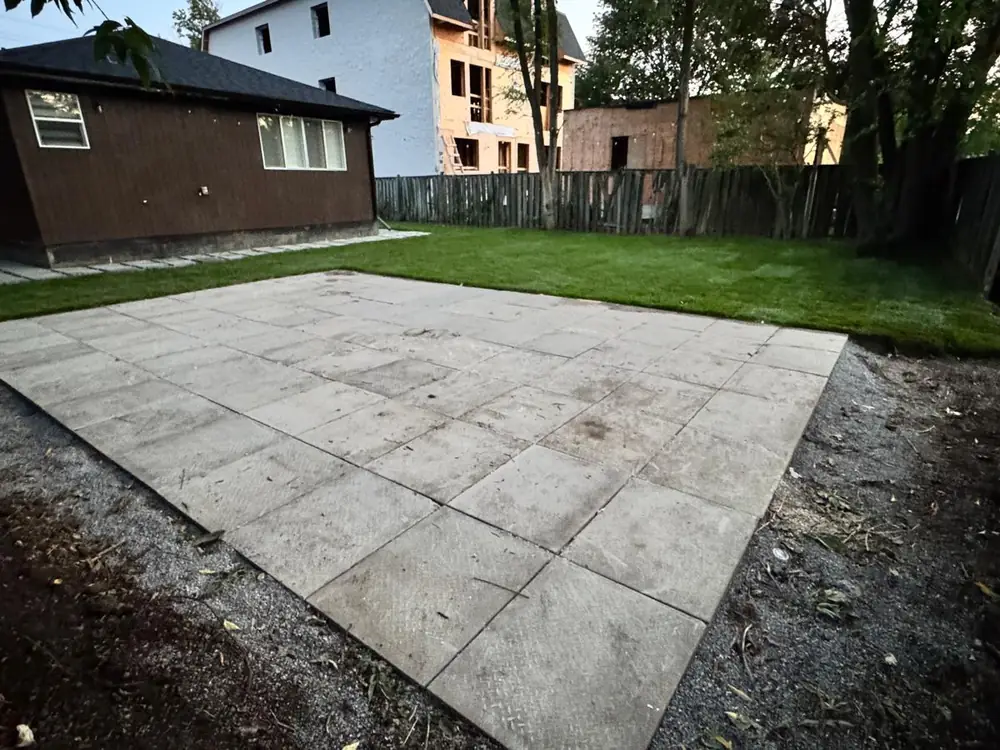
The base
- 300 mm compacted Granular A under a driveway
- Placed in 75–100 mm lifts
- Compacted between every lift
- Geotextile between base and subgrade
Identical requirement for all three surfaces.
Three surfaces, three different bargains. We install two of them and will tell you honestly when the third is the right answer. Here is the comparison.
Side by side
| Interlocking pavers | Concrete | Asphalt | |
|---|---|---|---|
| Install cost | Highest | Middle | Lowest |
| Lifespan | Longest, because repairable | Long, then cracks | Shortest cycle |
| Repair | Lift and reset the area | Patch shows, or replace | Patch and reseal |
| Utility access | Lift and relay | Cut and re-pour | Cut and patch |
| Ground movement | Flexes with it | Cracks | Tolerates, then deforms |
| Maintenance | Re-sand joints | Reseal | Reseal every few years |
| Salt | Quality units tolerate it | Surface scaling risk | Softens in heat, brittle in cold |
| Look | Modular, widest choice | Seamless, stamped options | Plain black |
| Best for | Front driveways, patios, anywhere seen | Large plain areas, budget-conscious | Long rural driveways |
The part that does not change
Whatever goes on top, the ground underneath decides how long it lasts. Concrete on a shallow base cracks, pavers sink, and asphalt deforms. The surface is a preference; the base is the build.
Identical requirement for all three surfaces.
Ask every quote, whichever surface it is for.
Choosing
We will say so rather than sell you pavers you do not need.
Questions
Interlock, because it can be repaired in place rather than replaced. Concrete lasts a long time and then cracks somewhere you cannot fix invisibly. Asphalt has the shortest cycle and needs resealing every few years.
Asphalt to install, then concrete, then interlock. Over twenty years the order shifts, because asphalt is resealed repeatedly, a cracked slab is lived with or replaced whole, and interlock is repaired section by section.
On a long rural driveway where the alternative is thousands of square metres of pavers, absolutely. On a suburban front driveway it is usually the false economy.
Then interlock is worth serious thought. Lifting and relaying a trench of pavers is a day's work; cutting and re-pouring a concrete slab leaves a visible scar forever.
Related
Free estimate
Fill this in and we'll get back to you to book a site visit — usually the same day.
Or call directly(647) 473-3454