
Below the boards
- Footings below the 1.2 m frost line
- Posts, beams and joists to span
- Ledger fastened and flashed
- Blocking and bracing
Where a deck fails, and where you cannot see it.
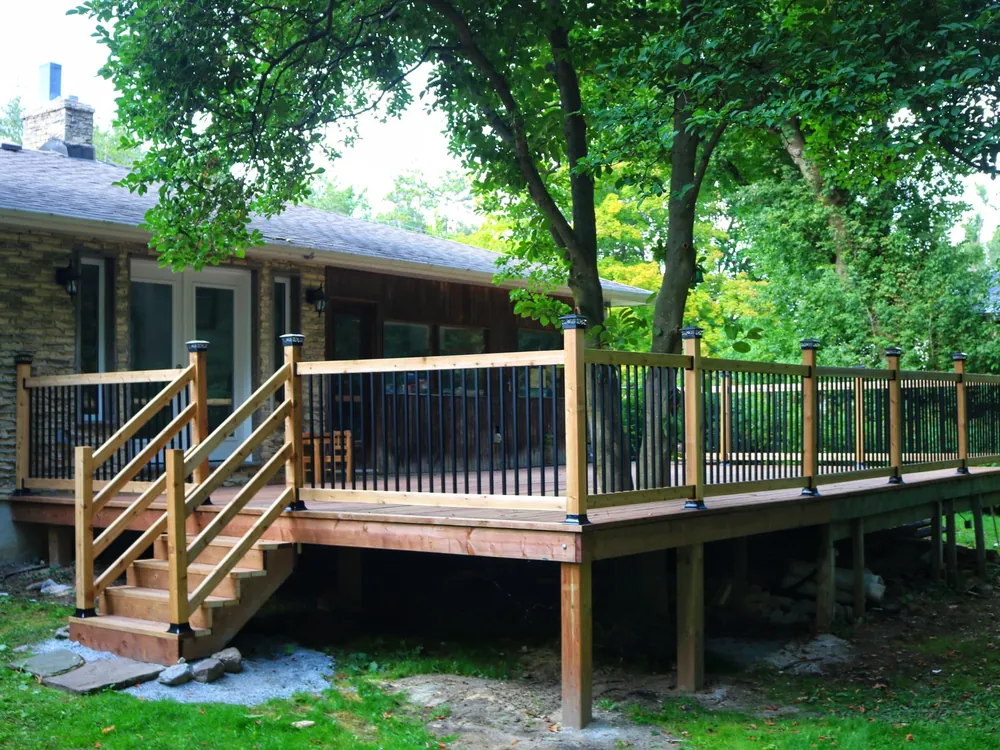
Deck pricing is driven by three things: area, height off grade, and what the boards are made of. Height is the one people underestimate — it brings footings, stairs, guards and often a permit with it. This page sets out what is in the job and what moves the number.
What you're buying
Where a deck fails, and where you cannot see it.
The drivers
Ranked by how much difference each one makes. The top row is usually the entire difference between two quotes.
| What changes | Effect on price | Why |
|---|---|---|
| Height off grade | Large | Above roughly 600 mm: permit, guards, longer stairs, heavier framing. |
| Decking material | Large | Composite board cost is a multiple of pressure-treated. |
| Railing system | Moderate to large | Glass and aluminum systems can rival the cost of the deck surface. |
| Re-board vs full rebuild | Large saving where possible | A sound frame removes footings and framing entirely. |
| Access for equipment | Moderate | Hand-digging footings in a closed backyard is slow work. |
| Stairs and landings | Moderate | Each run adds framing, treads, guards and footings. |
| Area | Scales close to linearly | Less fixed-cost dilution than a hardscape job. |
Getting a number
We publish real numbers rather than "it depends" — but only once they're ours to publish. Our written ranges are being finalised; call and we'll give you one over the phone in a minute. What moves the number:
Questions
On install day, clearly yes — the boards cost substantially more. Over ten years the gap closes: pressure-treated needs cleaning and staining every two to three years, and boards get replaced as they cup and split. Composite needs washing. The honest framing is not cheap versus expensive, it is pay now versus pay later, and which one suits you depends on how long you are staying.
Because height brings the expensive parts with it. Above roughly 600 mm you are usually into permit territory, guards become mandatory, stairs get longer, and the framing carries more load. A ground-level deck and a second-storey deck of the same area are not the same job.
Holes dug below the frost line — roughly 1.2 m in this region — filled and set so the deck does not lift when the ground freezes. They are slow, they generate spoil, and they are entirely invisible in the finished deck. Footings that stop short are the reason decks rack and pull away from the house after a hard winter.
Often, and it is a big saving. If the posts, beams and joists are sound and the ledger is properly flashed, re-boarding and new railings gets you a new deck for a fraction of a rebuild. If the posts are rotting at grade, boarding over it just hides the problem.
Related
Free estimate
Fill this in and we'll get back to you to book a site visit — usually the same day.
Or call directly(647) 473-3454