
Excavation
- Utility locates
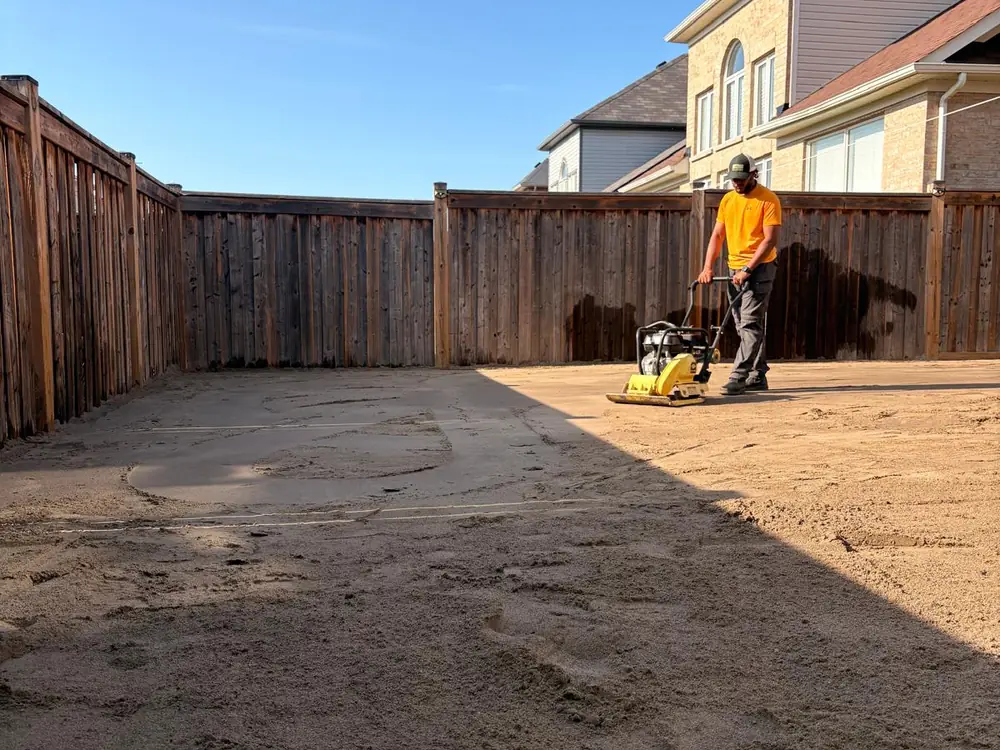
- Existing surface removed and hauled
- Dig to depth
- Subgrade compacted
Usually the largest single line in the job.
The honest answer is that base depth, access and disposal drive the number far more than the pavers do. This page sets out exactly what is in the job, what changes the price, and the questions that expose the difference between two quotes that look the same on paper.
What you're buying
Usually the largest single line in the job.
The part you never see, and the part that fails.
The only part most quotes describe in detail.
The drivers
Ranked by how much difference each one makes. The top row is usually the entire difference between two quotes.
| What changes | Effect on price | Why |
|---|---|---|
| Base depth: 150 mm vs 300 mm | Large | Twice the material, twice the compaction passes, twice the disposal from the extra dig. |
| Paver thickness: 60 mm vs 80 mm | Moderate | 80 mm units are the driveway-rated ones. 60 mm belongs on a walkway. |
| Machine access vs wheelbarrow | Moderate | A backyard reachable only by barrow can double the labour hours. |
| What's under the old surface | Moderate | Rubble or old concrete adds breaking, digging and tipping. |
| Curves, cuts and borders | Moderate | Every cut is handled twice and produces waste. |
| Paver selection | Moderate | Premium and natural stone can run several times the cost of standard precast. |
| Area | Scales, but not linearly | Fixed mobilisation and machine costs spread over a larger job. |
Estimate it
Enter your dimensions and this returns what our standard section actually requires.
Rough quantities only, at our standard section: compacted Granular A at the depth selected, placed in 75–100 mm lifts, plus a 25 mm screeded HPB bedding course. Paver count assumes a common 200 × 100 mm unit with 5% added for cuts. Send us the dimensions and we will put a price against them.
Getting a number
We publish real numbers rather than "it depends" — but only once they're ours to publish. Our written ranges are being finalised; call and we'll give you one over the phone in a minute. What moves the number:
Questions
Excavation and base — routinely more than the pavers themselves. Removing the existing surface, digging to depth, hauling the spoil away and bringing in and compacting 300 mm of Granular A is the bulk of the labour and most of the material weight. It is also invisible once the job is done, which is exactly why it is the first thing a cheap quote cuts.
Compare the base depth line. A driveway on 150 mm quotes far cheaper than the same driveway on 300 mm, looks identical on handover day, and settles within a few winters. Then compare paver thickness — 60 mm units are cheaper than 80 mm and are not rated for vehicles.
Not quite. Mobilisation, machine time and disposal have fixed elements, so cost per square metre usually drops a little as area grows. Complexity works the other way — curves, cuts, steps and borders all add labour per square metre.
To install, yes — asphalt is cheapest, then poured or stamped concrete, then interlock. Over twenty years the ranking changes: asphalt needs resealing every few years, concrete cracks permanently, and interlock can be lifted and reset section by section. We set the comparison out in full on the interlock versus concrete page.
No. On-site estimates are free and come with a written scope naming materials and base depth, which is what lets you compare quotes properly.
Related
Free estimate
Fill this in and we'll get back to you to book a site visit — usually the same day.
Or call directly(647) 473-3454